

Greenyard Prepared: “50% less product loss thanks to a temporary tent structure.”
Peas on your plate? There’s a good chance they were harvested and processed at Greenyard Prepared in Bree. And it was precisely these peas that prompted our collaboration with this producer of prepared fruit and vegetables. Hot summers – with 2026 being the hottest on record – and peas simply don’t go together. To guarantee its processing capacity, Greenyard had a temporary tent structure installed to provide the necessary shade and cooling.
Greenyard Prepared is one of the three divisions of the Greenyard Group, a global player in fresh, frozen and prepared fruit and vegetables. At both Bree and Rijkevorsel, the company produces food products for Europe’s largest retailers. These include all kinds of pulses, soups and sauces. Before being shipped to customers, the products are packed in cans, glass, Tetra Pak or flexible packaging.
The challenge: peas don’t wait
A significant proportion of these vegetables is grown by partner growers in Belgium, the Netherlands and Germany, within a radius of around 150 kilometres. From there, they are transported to Bree for further processing. Especially during the summer months, this requires extremely tight planning.
“Peas are one of the most sensitive vegetables we process,” says Johnny Van Holzaet, Managing Director at Greenyard Prepared. “From the moment they are harvested, we want to wash, sort, blanch, fill and sterilise them as quickly as possible. Ideally, the entire process takes place within six hours. But this is precisely where increasingly warmer summers create an additional challenge.”
Before Veldeman: pressure on processing capacity
Under normal weather conditions, Greenyard Prepared receives roughly the same volume of harvested peas every week.
“The sowing process is timed so that we receive just enough produce to match our processing capacity. During prolonged periods of hot weather, that pattern changes. At high temperatures, peas ripen much faster. As a result, a volume that would normally arrive over two weeks may suddenly need to be processed within a single week. This creates temporary additional pressure on our capacity.”
“So during these periods, we have to find ways of storing the peas for just long enough to still be able to process them. Freezing is not always possible or desirable. We therefore often store them temporarily outside in containers until we can process them. But a metal container exposed to the summer heat heats up extremely quickly. It effectively becomes a cooking pot. In recent years, we have regularly had to dispose of containers of peas because they started to sour.”
“That product loss is obviously unfortunate for us. But it is also a shame because a complete growing process has already gone into producing those peas. The efforts made by everyone from the farmers to the transporters were largely in vain as well.”
The turning point: what if we simply created shade?
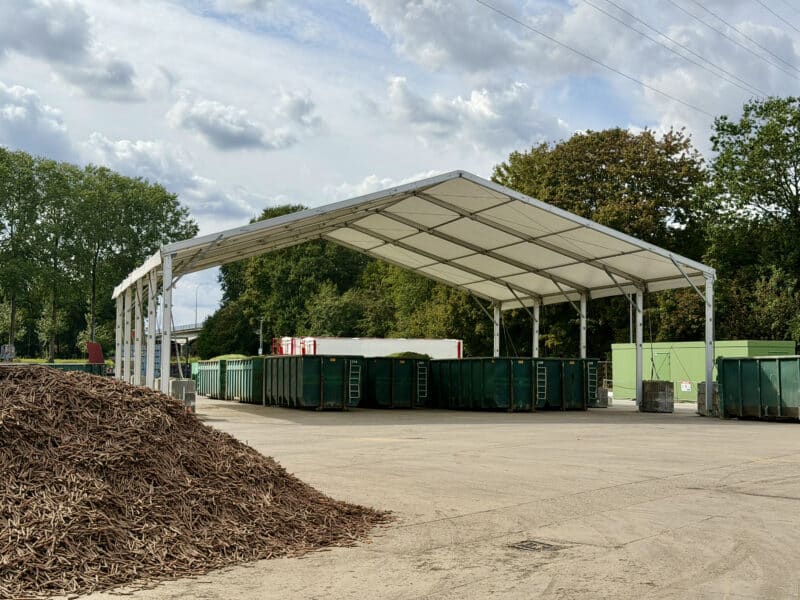
The solution to the problem turned out to be surprisingly simple: prevent the containers from being exposed to direct sunlight. However, there was no longer any permanent covered space available on the existing site for the incoming containers.
“Based on our previous contacts with Veldeman, the idea arose to install a temporary tent structure during the summer season. At one point, we learned that Veldeman uses its structures for many more applications than just events. That triggered the idea of testing a tent structure ourselves.”
Implementation: measuring, fine-tuning and putting it into practice
The idea emerged during the summer of 2025. “At that point, the pea season was already well underway. So we decided to use the remaining time to test whether a tent structure would make a sufficient difference to our operations.”
“The first results were immediately clear. We examined the temperature difference between containers in direct sunlight and containers under the structure. On the hottest days, the temperature inside a container could rise to around 45–50°C. Under the structure, it remained limited to around 35–37°C.”
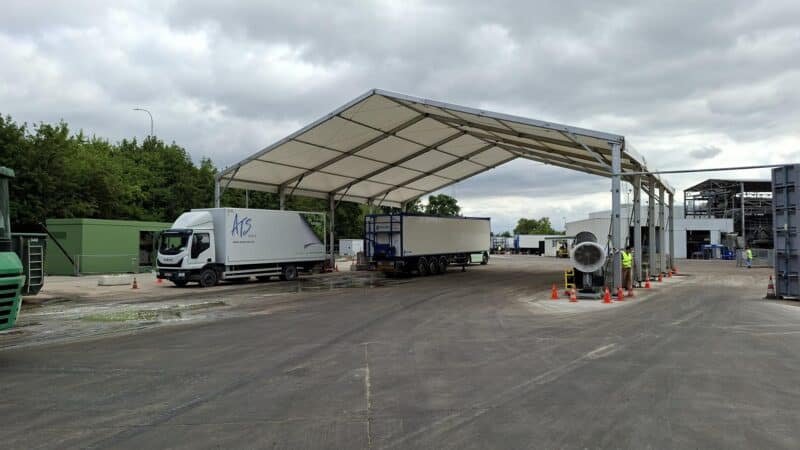
“And that was without even taking into account the additional effect of the misting system we had installed under the structure. Thanks to this combined solution, we were able to protect up to eight large containers and their contents from the strongest sunlight. The open sides, in turn, ensured sufficient air circulation.”
Based on this test period, Greenyard Prepared decided to use the structure again in 2026, this time from the start of the season. “We submitted our request in April. By the second week of June, the temporary tent structure was fully ready for use. We rented it until the end of September. We will probably call on Veldeman’s services again next year as well, so we can make the most of our production capacity.”
No more limits for Greenyard Prepared: the numbers
- Dimensions: 20 x 20 m
- Surface area: 400 m²
- Sidewall height: 5.4 m
- Installation time: 1 day
- Covered space for 6 to 8 containers
- Up to 15°C of natural cooling
The impact: significantly less product loss
For Greenyard Prepared, the main added value of the temporary tent structure is not the temperature measurement itself, but what that lower temperature ultimately delivers.
“Over the past summer, we had to dispose of 50% fewer containers due to souring peas than in previous years. And that was despite experiencing the highest temperatures ever recorded. For us, this was proof that we had made a sustainable and smart investment.”
The temporary cover also gives Greenyard Prepared more flexibility to organise the continuous flow of harvested produce. “We can also use this covered space as a buffer zone for products that do not need to be processed immediately. This allows us to make much better use of our available production capacity throughout the day.”
Also looking for some much-needed additional space?
Does your company need additional storage space, shelter or buffer capacity at certain times of the year, or perhaps even over a longer period? A temporary tent structure gives you exactly the space you need. Looking for a customised solution? That’s perfectly possible too. Discover which structure is the most suitable solution for your business.
Questions for a Veldeman advisor
Our professionals think along with you and are happy to shape your plans.